Inspection rounds
Deploy access at repeated checkpoints without assembling a full tower for every stop.

Fast deployment
Portable folding configurations help maintenance teams deploy, relocate and store access equipment efficiently.
Application overview
Folding fiberglass scaffolds reduce the number of loose setup steps for facilities that repeatedly deploy, relocate and store access equipment. They are best evaluated as a complete workflow: storage footprint, transport route, deployed platform height, access method and perimeter protection.
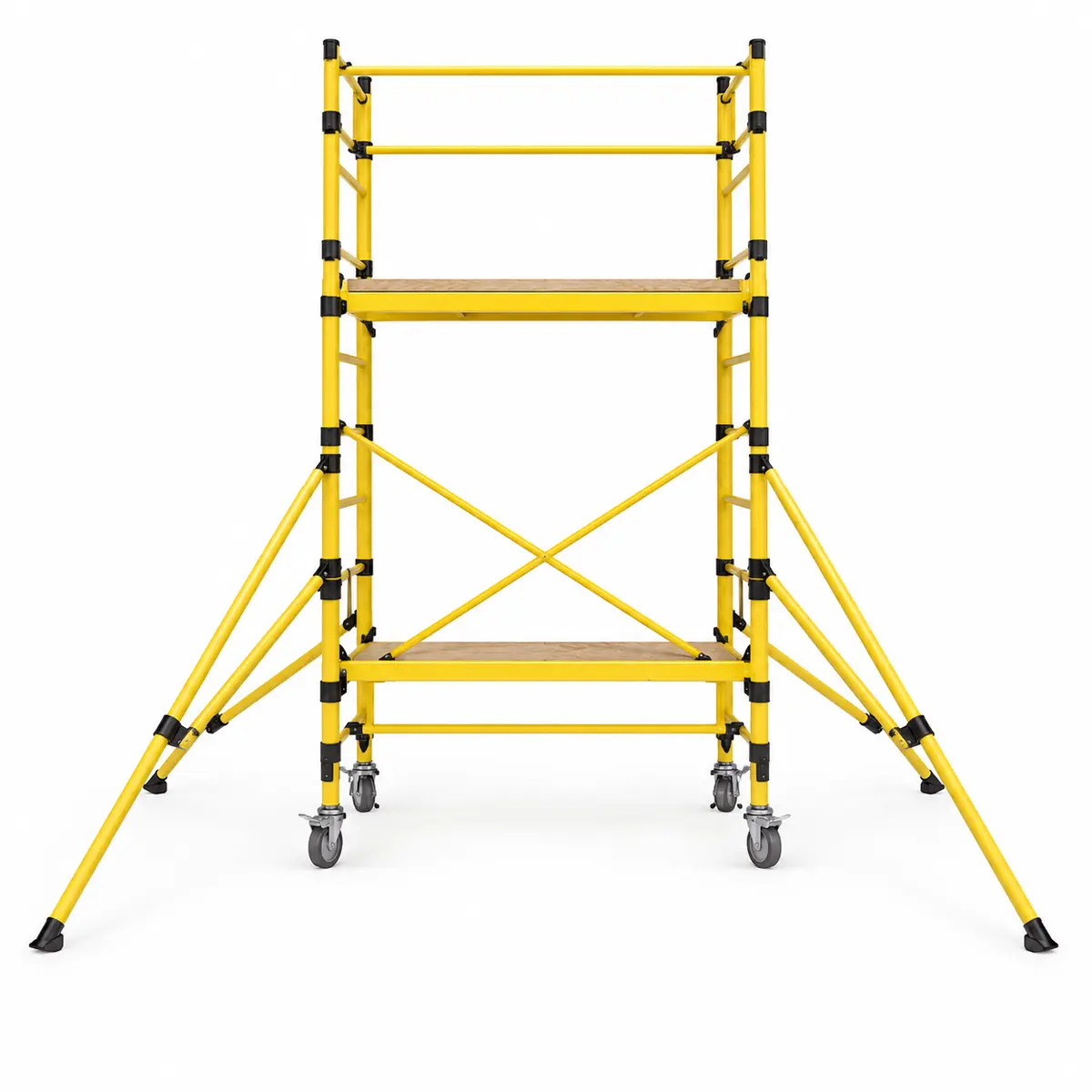
Where it fits
Real-world starting points for discussing the work, footprint and environment.
Deploy access at repeated checkpoints without assembling a full tower for every stop.
Move between lighting, controls, piping and overhead building systems.
Stage compact access equipment for defined tasks during planned maintenance windows.
Fold the base for storage where equipment rooms or maintenance shops have limited capacity.
Make a better decision
Folding equipment earns its place when it reduces setup friction across repeated tasks. A good evaluation includes the folded storage envelope, the rolling route, the opened footprint and the components that must be installed before use.
Document where the unit unfolds and when platforms, rails or stabilizers are added.
Keep the folded scaffold and loose components protected, identified and available as one package.
Standardize inspection and deployment steps when the unit moves among departments or buildings.
Common specification mistakes
Selection guidance
The useful footprint changes through the workflow. Confirm folded size, rolling width, setup clearance and final working envelope rather than relying on one advertised dimension.
Discuss Your Requirements01—05
Information to include
A better specification process
Documenting the work before choosing components reduces assumptions and helps compare practical options.
Reserve a protected location that fits the folded unit and components.
Check doors, elevators, corners, thresholds and floor conditions.
Allow room for opening, access and all required protective components.
Continue your research
Move between product, application and technical pages without losing the context of the current decision.
Page-specific answers
Clear answers help teams evaluate fit, collect the right project details and begin a productive conversation.
Ask a QuestionA folding base can simplify deployment and storage for repeatable facility tasks, subject to the complete supplied configuration.
No. Available heights and permitted extensions are product-specific and must be confirmed before selection.
Inclusions vary. Request a component-level quote showing the platform, access, guardrail, toe-board, caster and stabilization package.
Possibly, but the exact rolling width, height and route must be measured for the selected product.
Need the right configuration?
Share the application, footprint, environment and access requirements. We’ll help identify a practical next step.
Specialized companies. One access network.