Switchgear and control equipment
Plan compact access around cabinets, breakers and control equipment while preserving operating clearances and egress.

Substation access applications
Plan fiberglass scaffold access for substations and switchyards while maintaining required electrical clearances, site procedures and complete-system controls.
Application overview
Substation work can combine energized equipment, restricted approach zones, gravel or uneven surfaces, narrow equipment aisles, weather exposure and strict utility procedures. Fiberglass scaffold may be considered because of its non-conductive material properties, but material selection never replaces de-energization requirements, approach boundaries, PPE, grounding practices, barricades or the utility’s electrical safety program.
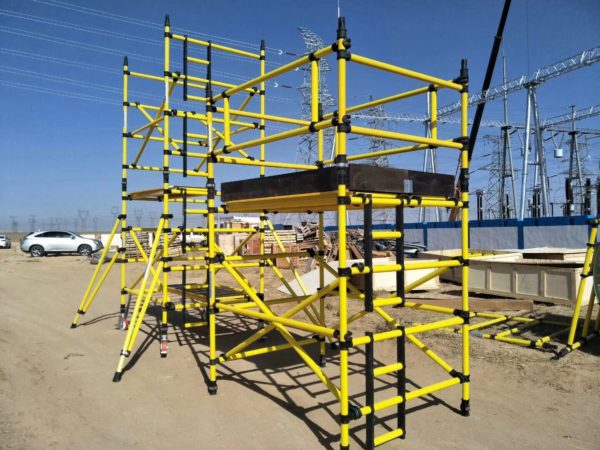
Where it fits
Real-world starting points for discussing the work, footprint and environment.
Plan compact access around cabinets, breakers and control equipment while preserving operating clearances and egress.
Document the full worker, tool and scaffold envelope relative to energized equipment and prohibited approach zones.
Use repeatable access for planned service points where the route, base surface and approved configuration support mobile or modular towers.
Account for gravel, drainage, wind, weather, uneven surfaces and the path from staging to the work position.
Selection guidance
A tower that physically fits between equipment may still be unsuitable if casters, stabilizers, workers or tools enter a restricted area. The inquiry should show the route, work position, equipment status and required standing elevation together.
Discuss Your Requirements01—05
Information to include
A better specification process
Documenting the work before choosing components reduces assumptions and helps compare practical options.
Record electrical boundaries, equipment geometry, surface and the complete movement route.
Choose width, platform length and height only after confirming clearance around the full system.
Use the system only after utility/site review, inspection and confirmation of the approved complete configuration.
Continue your research
Move between product, application and technical pages without losing the context of the current decision.
Page-specific answers
Clear answers help teams evaluate fit, collect the right project details and begin a productive conversation.
Ask a QuestionFiberglass structural members have non-conductive material properties, which can be valuable in electrically sensitive environments. That does not make the scaffold electrically protective or change required clearances.
Movement must follow the utility’s electrical safety procedures, required clearances, route controls and manufacturer instructions. Material choice does not authorize movement near energized equipment.
Describe gravel, concrete, grating, slopes, drains, curbs and other conditions that affect casters, base support and stabilization.
Provide work point, platform height, footprint, route, electrical condition, required clearances, surface, quantity and the desired delivery date.
Need the right configuration?
Share the application, footprint, environment and access requirements. We’ll help identify a practical next step.
Specialized companies. One access network.